Evaluation task 2: How does your media product represent particular social groups?
09:05Our Media product represents different social groups through a number of ways including Mise-en-scene, editing, sound and camera. Our primary social group that we represented was Regional Identity. Alongside regional identity, we represented the social group of Gender.
Within our opening sequence we portrayed the English vs the Russians as Good vs Evil. The portrayal of Regional identity constantly adheres to the stereotypes associated with this social group throughout the entire sequence. Mise-en-scene is one way in which the social group is shown. For example: when looking at character positioning both sides are obviously very separate from each other which connotes that there is opposition between the two regions. But even when looking at each group as separates, the English men stick very close together and help each other which connotes a good and positive relationship within the team.
 On the other hand, the Russian Men tend to stay quite distant for each other and mark their own territories- this may imply they don't need to rely on each other as much and may even seem fearless; this adhering to the stereotype of the Russians being strong, independent and insensitive Another way mise-en-scene portrayed a difference between the English side and the Russian side is by use of facial expressions. The Russians stay very serious throughout the sequence and don't seem too panicked on their faces when the bomb comes their way. In comparison to this, the English have more of a mixture of emotions, including scared, determined, distressed. This connoting that the English characters are more sensitive and again suggesting that they have a good bond with each other. This could imply that they are weaker because they are more effected by feelings. This again adhering to the stereotype of Russians being strong, powerful and have no mercy/ are insensitive. When looking at the set, there is little smoke when the Russian characters are in shot as the grenades going off, however, when the English characters are in shot with the smoke, they are almost consumed by it. This might connote the English's weakness as they are almost blinded to what is happening or about to happen. It could even be seen as something that may have caused Callum's death. The fact there was a clear view adheres to the Russian stereotype that they see and know everything.
 Lastly an example of when Mise-en-scene shows a different between the English and the Russian is through costume, the Russian's have more advanced clothing including a hood, a hat and red shoe laces, even though these are only small changes in costume, it connotes that they may have better upgrades in the game because of money and they are ably to buy these outfits and also care about how they look. This adheres to stereotype that Russians are very wealthy yet in comparison to this the stereotype of English men that are usually in the army are working class men therefore don't have as much money. This all proving Mise-en-scene was a key way in which helped with the portrayal of our primary social group.
Camera is another way which represents the difference between the English and the Russians inside the social group of regional identity. The camera helped adhere to both the English and Russian stereotypes and the difference in many ways. First of all, when the camera is on the Russians, it is mainly still and on a tripod which connotes calmness and how they are prepared; however, when it is on the English, hand held is mainly used. This could connote franticness and panic but also show that there is more action and the English are working harder. This adheres to the Russian stereotype that they are always prepared and don't need to try hard as they're naturally skilled whereas the English are hardworking and work well when in a team.
 Secondly, When the camera is on the English, it is mainly shot in close ups and mid shots, this could connote their close relationship with each other, make the viewer feel like they're closer to and on their side and it could show that the English have the most significance in this part of the thriller. In comparison to this, mainly long shots or extreme long shots are used on the Russian characters, it highlights that the characters are positioned further away from each other (more independence) but could also highlight how large and intimidating their bodies are. Another way the difference between the Russian men and the English men was displayed through use of camera is by angles. The camera on the English men are usually at a low angle, this could connote their importance to the scene, it could show that they are powerful as team but could also connote that they are trying to hide from something and are worried due to what they're hiding from. The shots on the Russian men are mainly at eye line which could be way of them seeming more intimidating as there are points when the characters look directly to the camera and shoot. This could make the audience feel uncomfortable and see the Russians as the evil side.
 To carry on from this idea about the audience taking sides, the camera constantly follows the English characters in hand held; this might make the viewer feel like they are with the characters during the action and are on their side. On the other hand, when the camera is on the Russian characters, it doesn't follow their action and the characters run out of shot. The camera remains still as if not wanting to follow this side of the fight connoting that the audience should want to stay away from the Russians and may even make them feel more emotionally attached to the English side. Camera was used carefully to represent the English and the Russians.
Editing is key when it comes to representing a social group. The opposition between the English and the Russians was shown clearly in many ways involving editing. First of all, the shot duration was a lot longer on the english than on the Russian; sections of the sequence are shot as a one-er showing the action occurring on the English side. This connotes that the English side is more important to the storyline and are the main focal point, unlike the Russian side which is only briefly shown. A way in which adheres the stereotype that Russians are skilled and powerful is when we speed modified when they are running away from the grenade.
 We sped this part up to make the sequence flow better but also show that the Russians have speed and more advantage to the English. Throughout the thriller there is a large amount of shot reverse shot used to show the competition and the good vs the evil. The Russians were seen as the evil which adheres to their stereotype of being cruel and in opposition, the English being good adheres to the polite and well brought up stereotype of an Englishman. When it came to editing the muzzle flashes, the Russians were give smaller muzzle flashes to maybe imply that the English have better weaponry. This connoting that the English side as a team may be more powerful that the Russian side, who are more spread out with less advanced weapons. This shows the importance of editing when representing a social group.

Lastly, when looking at regional identity, sound is another key aspect of how it was portrayed. First of all, there are a few exampled of effective ways non-diegetic sound is used to portray the conflict between the English and the Russians. The gun shot sound effects used for the English side are louder and sound more powerful than those used to represent the Russian side. This showing they could be closer to the viewer or have an advantage over the Russians when it comes to the weapons that they have access to. The fact that the gunshots are closer together connotes teamwork and unity.
 Multiple gun shot sound effects are used in the background coming fro the Russian side this connotes that the Russians are prepared and eager to fight- adhering to this stereotype. Diegetic sound is also effective when representing regional identity. There is a lot more english dialogue in this sequence, whereas the Russian men only say a little, they speak their own language which a British audience couldn't translate and what they say is only simple. This all connotes that the English have much more significance in the thriller and that the viewers should be more focused on what the English have to say. This again might make them feel like they are on the English side.
 Diegetic sound is also evident when the English men are running, you can hear the crunching of the leaves and grass when the English are in action which again may make the viewer feel as though they are with the English side. Sound is very important when displaying social groups.
Overall, in this social group, the Russians seem to have more skill, independence, a drive to fight and have a lot of money which they spend on looking good, whereas the English as seen with more importance to the scene, they work well as a team and the all of these elements make the viewer feel as though they are on their side. All of this adhering to the stereotypes of both regions.
Our secondary social group is gender; our thriller includes an all male cast with no female representation. This first of all connoting that stereotypically girls wouldn't be find themselves in this sort of scenario and suggests men are usually the ones who go into war and fight, it also suggests how men have a bigger urge for action and being spiteful. As well as this, is adheres to the stereotype that males tend to be the gender who would be playing warfare games.
 One way in which subverts to the male stereotype is through character positioning and diegetic dialogue when David is over Callum screaming at him in hysterics. This has feminine characteristics as David gets very emotional and attached to Callum. Although, overall, the male character adheres to the male stereotype as they're seen as a very tough and strong, active and have an interest in warfare and games.
In conclusion, the primary source is shown throughout the opening sequence in many more ways than our secondary source. There are a range of examples which portray the different between the Russian side and the English side which adhere to their obvious stereotypes. Gender on the other hand had less examples to write about as there was a complete absence of the female gender.
Within our opening sequence we portrayed the English vs the Russians as Good vs Evil. The portrayal of Regional identity constantly adheres to the stereotypes associated with this social group throughout the entire sequence. Mise-en-scene is one way in which the social group is shown. For example: when looking at character positioning both sides are obviously very separate from each other which connotes that there is opposition between the two regions. But even when looking at each group as separates, the English men stick very close together and help each other which connotes a good and positive relationship within the team.


Camera is another way which represents the difference between the English and the Russians inside the social group of regional identity. The camera helped adhere to both the English and Russian stereotypes and the difference in many ways. First of all, when the camera is on the Russians, it is mainly still and on a tripod which connotes calmness and how they are prepared; however, when it is on the English, hand held is mainly used. This could connote franticness and panic but also show that there is more action and the English are working harder. This adheres to the Russian stereotype that they are always prepared and don't need to try hard as they're naturally skilled whereas the English are hardworking and work well when in a team.


Editing is key when it comes to representing a social group. The opposition between the English and the Russians was shown clearly in many ways involving editing. First of all, the shot duration was a lot longer on the english than on the Russian; sections of the sequence are shot as a one-er showing the action occurring on the English side. This connotes that the English side is more important to the storyline and are the main focal point, unlike the Russian side which is only briefly shown. A way in which adheres the stereotype that Russians are skilled and powerful is when we speed modified when they are running away from the grenade.


Lastly, when looking at regional identity, sound is another key aspect of how it was portrayed. First of all, there are a few exampled of effective ways non-diegetic sound is used to portray the conflict between the English and the Russians. The gun shot sound effects used for the English side are louder and sound more powerful than those used to represent the Russian side. This showing they could be closer to the viewer or have an advantage over the Russians when it comes to the weapons that they have access to. The fact that the gunshots are closer together connotes teamwork and unity.


Overall, in this social group, the Russians seem to have more skill, independence, a drive to fight and have a lot of money which they spend on looking good, whereas the English as seen with more importance to the scene, they work well as a team and the all of these elements make the viewer feel as though they are on their side. All of this adhering to the stereotypes of both regions.
Our secondary social group is gender; our thriller includes an all male cast with no female representation. This first of all connoting that stereotypically girls wouldn't be find themselves in this sort of scenario and suggests men are usually the ones who go into war and fight, it also suggests how men have a bigger urge for action and being spiteful. As well as this, is adheres to the stereotype that males tend to be the gender who would be playing warfare games.

In conclusion, the primary source is shown throughout the opening sequence in many more ways than our secondary source. There are a range of examples which portray the different between the Russian side and the English side which adhere to their obvious stereotypes. Gender on the other hand had less examples to write about as there was a complete absence of the female gender.
Evaluation task 1: In what ways does your media product use, develop or challenge forms and conventions of real media products?
04:17In what ways does your media product use, develop or challenge forms and conventions of real media products?
Editing Post-production
13:56During the editing process of our Thriller, we all took it in turns on who was working the computer, who was helping give ideas on where to cut and the order in which the shots were to be placed. We were expected to create a clip of around 2 minutes as an opening to a thriller film. To edit we used Adobe Premier Pro.
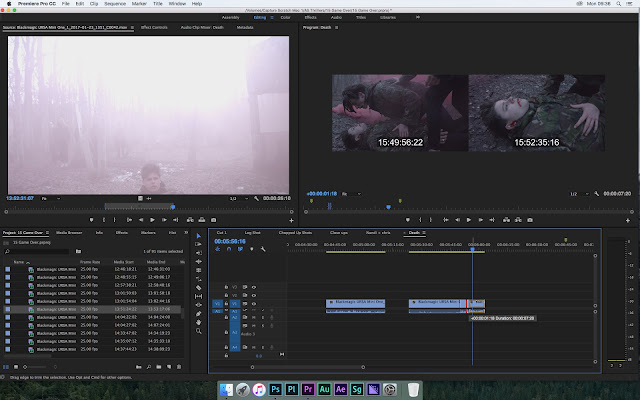
We reviewed and selected shots that we thought would be useful for the opening sequence, we put these shots in a timeline which we named log shot so that if we wanted to access the best footage quickly we could just go into there and find it; it also meant that unusable footage wouldn't get in the way. We opened new timelines for different cuts that we put together and for shots that we cropped to the sizes we wanted. We renamed our clips in the rushes because then the clips needed would be easier and a lot quicker to find. The timeline was used to order clips and so that we could clearly look at the shots we had and cut them to the correct size needed. The framing of the shot influenced whether it was used or not because it had to be in the right framing from the clip before and after to sustain continuity.

We cropped the majority of our shots for many reasons, these including: the shot was too long (some shots were a whole sequence in handheld so couldn't use the whole thing), people being in the background was a problem and led to us cropping shots, some shots were just more interesting cropped and also the face paced editing impacts the action by making it all seem to be moving faster. We used the cutting tool a lot, it allowed us to cut mid way through a shot, add another shot in between and have the rest of the shot continue after. This meant it was easier to portray call and response and made the shots flow better. Cropping and cutting shots made us think about which angles and shots we wanted in which order that fits the best so that the whole thing had good continuity. Once the shots were tidied and we thought about its composition, we arranged them on the timeline in a certain way: we placed the shots next to each other but placed them on different rows meaning that if we wanted to alter and crop parts so that the continuity was better, it was easier. On the timeline, we used different layers including: Cut 1, cut 2, Chopped up shots, Close ups and death scene. This made it a lot easier when it came to looking for and finding shots. It also allowed us to save different versions of how we could edit the sequence. For example, in cut 1 it includes the original full sequence of how we thought the opening could look. After that we made cut 2 which was a duplicate of cut 2 and we edited it to make the continuity better and to see if different shots in different places could look better. It lets us have Cut 1 saved to go back to if its unsuccessful.

For sound, we started with dialogue, adjusting its volume and cropping parts so that it all makes sense and fits together. We then moved onto background noise, to add to the action packed atmosphere. After that we moved onto sound effects; we used a variety of gun shot and explosion sound effects to match the action. As the boys entered the bus we included a wind sound effect to make it as realistic as possible and add more tension. When it came to the titles we wanted to keep it simple and use a classic font in white writing on a black background. We edited the size and the adjusted the placement on screen. To create the glitch effect on the title, we cut out the sound and the title and then brought it back as if it was flashing up on the screen and then lagging.

A main part of the editing process was the CGI after effects, we added muzzle flashes and explosion effects to add to the action style sequence and emphasise that what is happening is in a War game.

We reviewed and selected shots that we thought would be useful for the opening sequence, we put these shots in a timeline which we named log shot so that if we wanted to access the best footage quickly we could just go into there and find it; it also meant that unusable footage wouldn't get in the way. We opened new timelines for different cuts that we put together and for shots that we cropped to the sizes we wanted. We renamed our clips in the rushes because then the clips needed would be easier and a lot quicker to find. The timeline was used to order clips and so that we could clearly look at the shots we had and cut them to the correct size needed. The framing of the shot influenced whether it was used or not because it had to be in the right framing from the clip before and after to sustain continuity.

We cropped the majority of our shots for many reasons, these including: the shot was too long (some shots were a whole sequence in handheld so couldn't use the whole thing), people being in the background was a problem and led to us cropping shots, some shots were just more interesting cropped and also the face paced editing impacts the action by making it all seem to be moving faster. We used the cutting tool a lot, it allowed us to cut mid way through a shot, add another shot in between and have the rest of the shot continue after. This meant it was easier to portray call and response and made the shots flow better. Cropping and cutting shots made us think about which angles and shots we wanted in which order that fits the best so that the whole thing had good continuity. Once the shots were tidied and we thought about its composition, we arranged them on the timeline in a certain way: we placed the shots next to each other but placed them on different rows meaning that if we wanted to alter and crop parts so that the continuity was better, it was easier. On the timeline, we used different layers including: Cut 1, cut 2, Chopped up shots, Close ups and death scene. This made it a lot easier when it came to looking for and finding shots. It also allowed us to save different versions of how we could edit the sequence. For example, in cut 1 it includes the original full sequence of how we thought the opening could look. After that we made cut 2 which was a duplicate of cut 2 and we edited it to make the continuity better and to see if different shots in different places could look better. It lets us have Cut 1 saved to go back to if its unsuccessful.

For sound, we started with dialogue, adjusting its volume and cropping parts so that it all makes sense and fits together. We then moved onto background noise, to add to the action packed atmosphere. After that we moved onto sound effects; we used a variety of gun shot and explosion sound effects to match the action. As the boys entered the bus we included a wind sound effect to make it as realistic as possible and add more tension. When it came to the titles we wanted to keep it simple and use a classic font in white writing on a black background. We edited the size and the adjusted the placement on screen. To create the glitch effect on the title, we cut out the sound and the title and then brought it back as if it was flashing up on the screen and then lagging.

A main part of the editing process was the CGI after effects, we added muzzle flashes and explosion effects to add to the action style sequence and emphasise that what is happening is in a War game.
Similar products
12:33Below are some movies, TV shows, Video Games and Music videos which have some similarities to our opening sequence. Whether its location, key themes: Gaming/virtual reality and War, Genre or similar storyline, they all are similar in some way. Its great to know of other similar products as you can use it in a way of inspiration or even comparison.
Movies:
Gamer (2011)
Lawnmower man 1 and 2
Tron (1982)
Tron Legacy (2010)
Lets be Evil (2016)
Saving Private Ryan (1998)
Martix 1-3

TV Shows:
Black Mirror-Season 3 episode 1, San Junipero episode
ReBoot (1994)
Fairly Odd Parents, Season 2 episode 1

Video games:
Call of Duty Franchise
Battlefield

Music videos:
Thirty seconds to Mars- This Means War
The Weeknd- False Alarm

Movies:
Gamer (2011)
Lawnmower man 1 and 2
Tron (1982)
Tron Legacy (2010)
Lets be Evil (2016)
Saving Private Ryan (1998)
Martix 1-3

TV Shows:
Black Mirror-Season 3 episode 1, San Junipero episode
ReBoot (1994)
Fairly Odd Parents, Season 2 episode 1

Video games:
Call of Duty Franchise
Battlefield

Music videos:
Thirty seconds to Mars- This Means War
The Weeknd- False Alarm

Shoot Day Reflection
04:12


Behind the scenes Video
12:32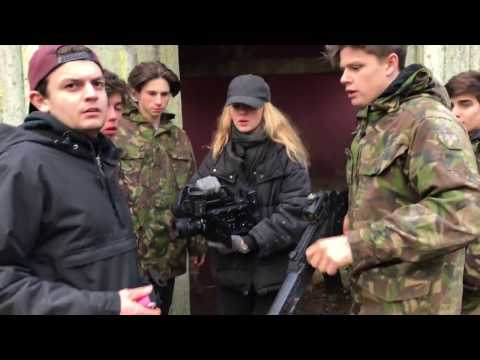
From footage shared between my group from our shoot day, I have edited a video together of the fun we all got up to on the day:
This footage provides evidence of team work and a hard working team (our group alongside the actors). I am so happy i have made this video because I can now look back at memories of the great and exciting day we had.
This footage provides evidence of team work and a hard working team (our group alongside the actors). I am so happy i have made this video because I can now look back at memories of the great and exciting day we had.
Our Shoot Day
12:28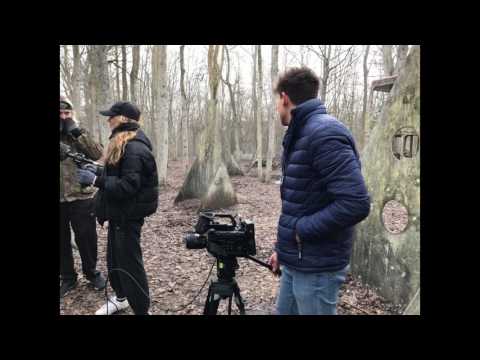
As a group we made sure that we collected images throughout the day of us working as a team behind the scenes. Chris put together a slide show displaying these photos, which is below:


